
Middlesex Scheduled and Actual Release
A projected or calculated date is an estimate produced under the sentence, credit rules, and facts known at the time. It can guide planning, but it does not prove that a person left custody. Actual release occurs only after the jail or VADOC completes its checks, signs the required papers, resolves any lawful holds, and records a departure or custody handoff.
For Middlesex County, the first dividing line is pretrial versus sentenced custody. A person held at Middle Peninsula Regional Security Center before judgment has no set sentence-completion date. Bond, a magistrate or court order, and case disposition control the path. A sentenced person may have a calculation, but the responsible office depends on sentence length and legal authority. VADOC computes qualifying longer or state-responsible terms, while local authorities can compute shorter local terms.
A transfer is another key distinction. Leaving MPRSC for VADOC, another jail, a hospital, or an agency detainer ends one custodian's stay without ending incarceration. Record both the sending and receiving agency.
Find Middlesex Projected Release Dates
Start with the custody system. For a local Middlesex charge, check the MPRSC current roster for identity and booking clues, then ask the jail which authority calculated the sentence. For a state-responsible prisoner, use the VADOC Inmate and Supervisee Locator. The locator accepts the first three letters of the first name with the full last name, or a seven-digit DOC ID. Optional filters include location, race, gender, and age range.
The VADOC tool covers more than prison buildings. It can include district-office supervisees, qualifying people in local or regional jails under VADOC authority, institutional hospitals, and CCAP. A community-supervision result therefore can show that physical incarceration ended while a legal term remains active. The locator is updated daily and warns that information may be inaccurate or out of date.
- Identify the current or last custodian from the booking, court, or transfer record.
- Use the DOC ID for VADOC when known; otherwise search the required name fields.
- Preserve the exact label, such as parole eligibility, mandatory parole, good-time release, or release date.
- For local time, request the MPRSC calculation record and the sentencing order.
- Ask about unresolved detainers, later sentences, amendments, and disciplinary changes.
- Verify the actual event through release papers or a custody-movement record.
The broader Middlesex County released inmate search helps when the question is whether a past departure occurred rather than when a future date may arrive.
VADOC Middlesex Release Date Labels
Virginia does not use one universal projected date. VADOC Operating Procedure 050.1 identifies projected parole eligibility, mandatory parole, and good-time release dates as calculated at the time of an inquiry. Eligibility is when review may begin. Mandatory parole and good-time dates reflect legal calculations, but both can remain subject to verification, changes, and detainers.
The official VADOC Time Computation page describes the governing credit systems and calculation factors.
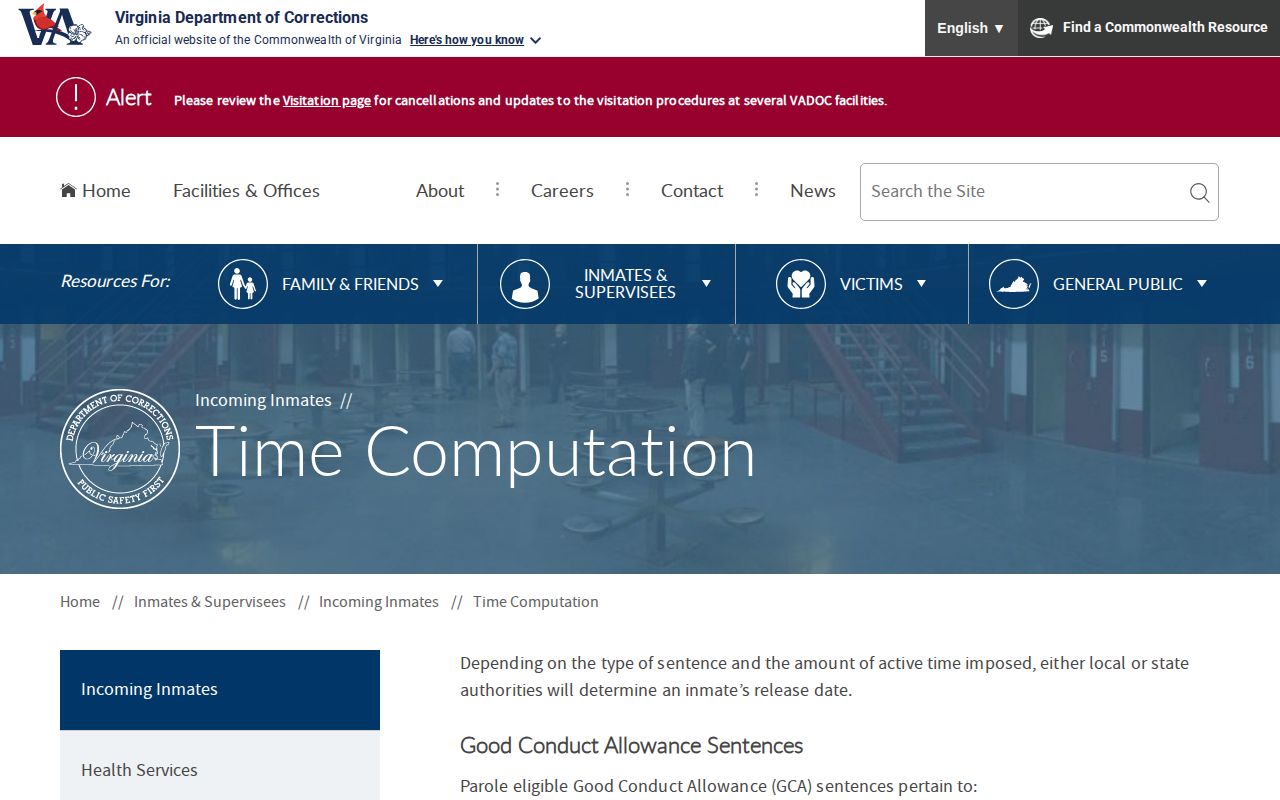
The pictured state page is the right source for the method. It is not a calculator that should be used to produce an unofficial date from a docket summary.
| Date label | What it answers | Key limit |
|---|---|---|
| Projected parole eligibility | When an eligible case can reach parole consideration | Eligibility is not a grant or release. |
| Mandatory parole | A statutory release point for an applicable sentence | Final checks and holds still matter. |
| Good-time release | A calculated date after applicable credits | Credits and classifications can change. |
| Actual release | The completed custody event | May be community release or a handoff. |
| Supervision end | When parole or probation formally ends | It is not the prison exit date. |
Middlesex Sentence Credits in Virginia
Virginia's calculation depends on the offense date and legal category. Good Conduct Allowance, or GCA, generally concerns felonies before January 1, 1995 and misdemeanors before July 1, 2008. Under the older statutes, the class can yield from zero to thirty credit days for each thirty served. Modern felony offenses committed on or after January 1, 1995 generally use Earned Sentence Credits, or ESC, and most are not eligible for ordinary discretionary parole, subject to statutory exceptions.
Virginia Code § 53.1-202.3 divides modern credit treatment. Offenses listed in subsection A can earn no more than 4.5 days for each thirty served. That rule is often shortened to “85%,” but the common phrase is imprecise. Thirty days served plus 4.5 credited days is about 87 percent of the credited cycle. Other eligible subsection B offenses may earn fifteen, 7.5, 3.5, or zero days for each thirty, based on level.
Pre-reception jail credit also matters. Virginia Code § 53.1-187 requires credit for qualifying pretrial confinement. VADOC lists total active time, sentence type, credit level, jail credit, disciplinary offenses, and later events among its variables. There is no safe one-line calculation for all Middlesex County sentences.
- Active time
- The part of a sentence that must be served, apart from suspended time.
- GCA
- The older Good Conduct Allowance framework for qualifying sentences.
- ESC
- Earned Sentence Credits used for modern qualifying felony sentences.
- Detainer
- A request or order for another authority to take custody.
- Discharge
- The formal end of the relevant custody or supervision term.
Why Middlesex Release Dates Change
A date can move even when the original judgment stays the same. Credit classifications are reviewed, credits can be forfeited, and new records can alter the calculation. A court may amend a sentence or impose added time. An unresolved warrant, detainer, civil hold, or uncalculated sentence can stop a community release and create a transfer instead.
| Factor | Possible effect | Record to check |
|---|---|---|
| Credit level | Changes the rate at which eligible credit accrues | VADOC computation record |
| Discipline | Can reduce or forfeit credits | Official classification and discipline record |
| Jail credit | Adds qualifying time already served | Court order and computation record |
| New or amended order | Changes active time or how terms run | Sentencing court docket and order |
| Detainer or warrant | May cause a custody handoff instead of community release | Final release verification |
| Parole action | May authorize release or continue review | Board decision and VADOC papers |
OP 050.1 provides a route to seek correction of erroneous record material. When an approved correction changes sentence time, VADOC must recompute the date. The person should use that official process rather than relying on a private calculation.
Note: A court's sentencing date, an alert timestamp, and the jail's processed exit time may all be valid but describe different events.
Middlesex Weekend Release Date Rules
MPRSC has a local timing quirk for court-authorized weekend service. Under Virginia Code § 53.1-131.1, a qualifying term of forty-five active days or less may be served nonconsecutively. The MPRSC weekender page directs participants to report at 6:00 p.m. Friday unless their papers state another time.

The official page documents Friday surrender and the nonconsecutive structure, but it does not publish the Sunday departure hour. Call MPRSC at 804-758-2338 for a specific event.
Each Sunday departure is temporary. It is not the final sentence completion. The person returns for the next required weekend until all service is complete. Lateness, prohibited substances, a major violation, or missed reporting can lead to a capias or conversion to continuous confinement. A roster snapshot taken between weekends can therefore suggest a final release when the sentence is still being served.
Middlesex Local and State Calculations
For a local sentence, ask MPRSC which authority performed the computation and request the existing calculation record. Pair it with the court's commitment or sentencing order. MPRSC is at 170 Oakes Landing Road, Saluda, Virginia 23149, and its main number is 804-758-2338. The jail record should supply the processed exit or transfer, while the court record supplies legal authority.
For state-responsible time, direct calculation questions to VADOC. The Correspondence Unit and Court and Legal Section receives mail through P.O. Box 26963, Richmond, Virginia 23261, with 6900 Atmore Drive used in its address details. VADOC's main number is 804-674-3000. A narrow request should identify the person and ask for the public status and calculated-date items available under OP 050.1.
A person can remain physically at MPRSC for part of a state-responsible sentence. Do not infer that the regional jail, rather than VADOC, owns the controlling calculation. First identify the legal authority. Then ask the office that created the figure.
Middlesex Transfer Clues and Recalculation
MPRSC's property procedure offers a useful local clue when a projected departure becomes a transfer. After a person moves to another jail, a psychiatric hospital, VADOC, or a similar facility, MPRSC calls for a Disposition of Personal Property form. The named person must show identification and sign for the property. The published rule gives the designee thirty days to collect it before destruction under policy.
The MPRSC inmate property page describes that transfer process. It does not apply as a universal community-release procedure, and it does not state the release disposition on its own. Still, the form can corroborate that a name left the current roster because custody moved elsewhere. Ask for the custody-movement record to identify the receiving agency and date.
A calculation error has a different remedy. VADOC Operating Procedure 050.1 allows correction of erroneous record material. If the approved correction affects time, the sentence must be recomputed. Send the claim through the official records process with the DOC ID, the disputed field, and the court or agency document that supports the correction. Do not ask MPRSC to change a state calculation it did not create.
These two paths solve different problems. Property paperwork can point toward transfer. The VADOC correction route addresses the number used for state time. Neither proves actual release to the community without a final custody record.
Confirm Middlesex Actual Release Dates
VADOC's facility release process calls for signed release documents, a final check, property handling, funds, and transportation steps.
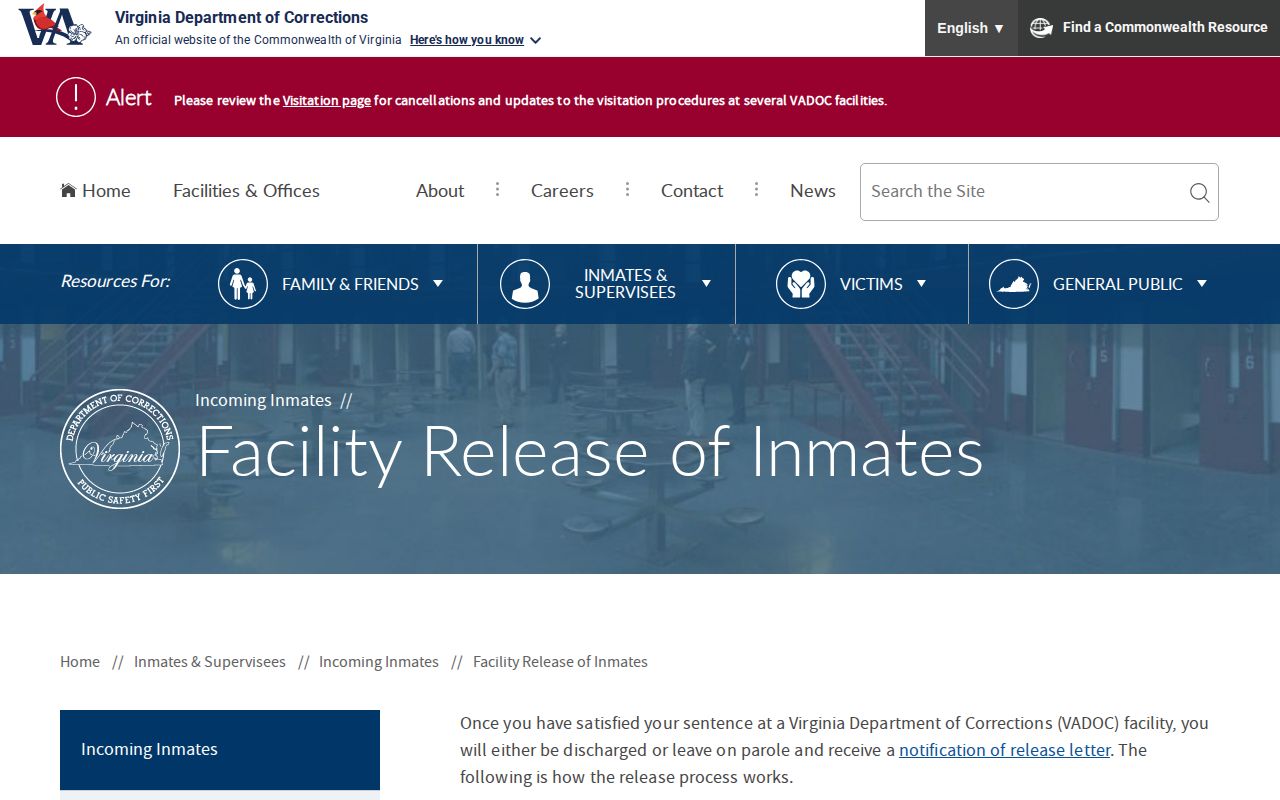
The state release page shows why a projected date must be followed by actual-event proof. Final documents can state the release method and supervision directions.
For a pending local-jail event, Virginia Jail VINE can send a custody-change alert. For state-prison notifications, VADOC now uses the separate NAAVI system for eligible victim registrants. The Middlesex VINELink release check explains that local enrollment does not automatically carry into the state system. An alert can lag and may describe transfer, so confirm it with the reporting custodian.
The best conclusion keeps its scope: “projected for release,” “released from MPRSC to VADOC,” “released from VADOC to supervision,” or “fully discharged according to VADOC.” Precise wording prevents a planned date or custody handoff from being mistaken for a completed return to the community.